
case studies
what we do
Vocal clean, treatment and positioning
Nick and Hils wanted Shakespeare’s Sonnet 116 set to music while they signed the register. They had discovered a recording of the poem being recited by Sir Laurence Olivier (from a 1973 chat show) and wanted it incorporated into the arrangement.
While this could have been achieved using free software such as GarageBand, the original recording contained significant background noise and required restoration. The audio was cleaned and processed before being meticulously integrated with the music, ensuring the spoken words and accompaniment complemented each other naturally, rather than simply running alongside one another.
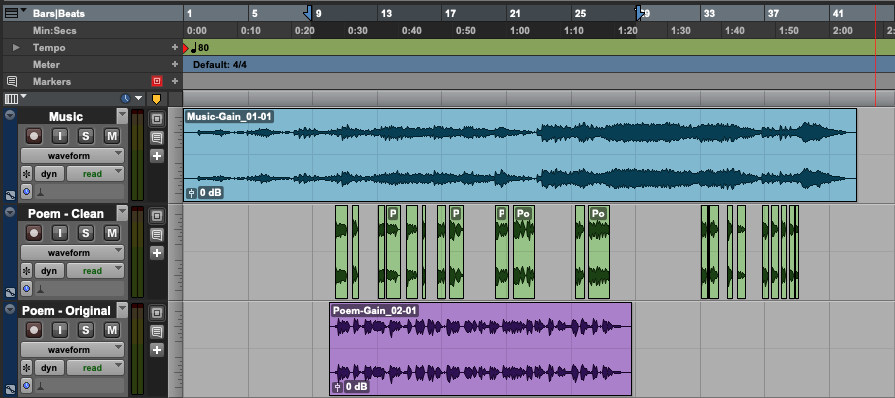
The image above shows the music (in blue) with the StingMasters edited / positioned Sir Laurence Olivier recording in green and then finally the original recording in purple.
ORIGINAL RECORDING SET TO MUSIC
CLEANING THE VOCAL
EQ / SMOOTHING / FX
MASTERING
STINGMASTERS
Creating a sting that sings
The moment the winner of an award is announced or the walk-on music for a host at a live event, you want the room to erupt. No matter what the award, who the winner is or what event – each sting needs to deliver impact.
There needs to be consideration for how long the track should be, someone sat at the back of room will take longer to walk to the stage than someone at the front.
What part of the song is being used? Is that section (e.g. chorus) long enough before it moves into the verse part? Do you need a seamless loop, but with something at the start? What db should the final output be?
There are many ways to do this and describe the process, however we think the best way to show you is for you to listen to our work.
Original Version
AI attempt
SOFTWARE / LIVE
Mastering
Stingmasters
Original Version
AI attempt
SOFTWARE / LIVE
Mastering
Stingmasters
Creating a sting that sings
The moment the winner of an award is announced or the walk-on music for a host at a live event, you want the room to erupt. No matter what the award, who the winner is or what event – each sting needs to deliver impact.
There needs to be consideration for how long the track should be, someone sat at the back of room will take longer to walk to the stage than someone at the front.
What part of the song is being used? Is that section (e.g. chorus) long enough before it moves into the verse part? Do you need a seamless loop, but with something at the start? What db should the final output be?
There are many ways to do this and describe the process, however we think the best way to show you is for you to listen to our work.
StingMasters vs AI
AI can make technical edits to a track, such as cutting and joining sections at specific time points. What it can’t do is recognise the subtle musical cues that make an edit feel natural, or suggest a better section of the song to achieve a smoother transition.
Seamless edits rely on musical instinct, careful listening, and creative decision-making.
Qualities that remain firmly human.
For this example, we are using the 4-Track edit from the Funeral section. Our finalised track and then examples of the transitions of StingMasters vs AI.
4-track stingmaster edit
stingmasters vs ai
Mastering
Mastering is the final stage of music production, where a track is polished and optimized for release.
It enhances overall clarity, balance, loudness, and consistency, ensuring the song sounds professional across different playback systems such as headphones, speakers, and streaming platforms.
Mastering also helps maintain sonic cohesion when playing several stings at the same event and prepares audio to meet technical standards, to give it the final ‘sparkle’ often lacking in unmastered tracks.
The examples all start with the original mix and transition into the mastered track.
mastering#1
MASTERING#2
MASTERING#3
MASTERING#4
mastering#1
MASTERING#2
MASTERING#3
MASTERING#4
Mastering
Mastering is the final stage of music production, where a track is polished and optimised for release.
It enhances overall clarity, balance, loudness, and consistency, ensuring the song sounds professional across different playback systems such as headphones, speakers, and streaming platforms.
Mastering also helps maintain sonic cohesion when playing several stings at the same event and prepares audio to meet technical standards, to give it the final ‘sparkle’ often lacking in unmastered tracks.
The examples all start with the original mix and transition into the mastered track.